
Struggling with compulsive eating? Use these 7 proven steps on how I stopped binge eating to get a healthier relationship with food without restrictive diets.
Have you tried to quit binge eating, only to find you can’t stop? You may feel scared, discouraged, and desperate. I was a binge eater for most of my life, and by God’s grace I was able to stop and have been in recovery for many years.
Read on to find out how I did it, and how you can do it, too.
- At a Glance: How I Stopped Binge Eating and You Can, Too
- What is Binge Eating Disorder (BED)?
- Binge Eating: My Story of Healing and Recovery
- 7 Proven Tips On How To Stop Binge Eating (Without Restrictive Diets)
- How To Stop Binge Eating At Night
- How To Quit Binge Eating Sugar, Sweets, & Junk Food
- Quitting Binge Eating From Stress
- Feeling Stuck? Take This Free 3-Minute Weight Loss Sabotage Quiz
- Resources for Binge Eating Recovery
At a Glance: How I Stopped Binge Eating and You Can, Too
- Binge eating is a treatable disorder marked by eating large amounts of food, feeling out of control, and shame afterward. It is different from emotional eating, though the two often overlap.
- The fastest way out is ending food restriction. Eating enough calories consistently throughout the day breaks the binge-guilt-restrict cycle that keeps most bingeing going.
- Recovery is a slow miracle, not an overnight fix. Surrender to God, replace shame with compassion, take imperfect action now, step back from the scale, understand your genetic wiring, and set up your environment for success.
What is Binge Eating Disorder (BED)?
According to the National Eating Disorders Association (NEDA), Binge Eating Disorder is characterized by:
- recurrent episodes of eating large quantities of food
- a feeling of a loss of control during the binge
- experiencing shame, distress or guilt afterward
- not regularly using unhealthy compensatory measures (e.g., purging) to counter the binge eating (because people who binge and purge, such as with vomiting, may be diagnosed with another eating disorder such as bulimia).
Put in layman’s terms, binge eating is regularly eating large amounts of food to the point of physical pain.
Binge eating is treatable and responds best to professional help. Find treatment and support on the NEDA website, or contact your doctor or insurance company for a referral. This article is my story and not meant to be a replacement for medical advice.
Feeling Stuck? Take This Free 3-Minute Weight Loss Sabotage Quiz
Most women who struggle with their weight are dealing with something deeper. Take this quiz to find out what’s really triggering you:
Binge Eating: My Story of Healing and Recovery
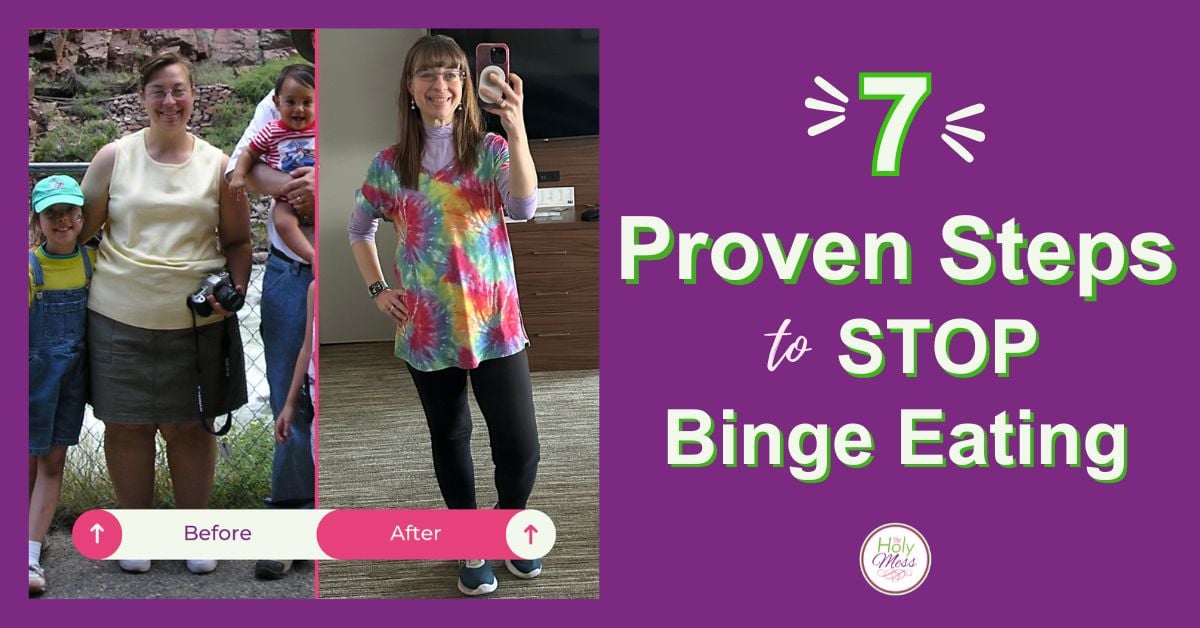
For much of my life, I was a binge eater. I sought treatment in my early 30s, which led to quitting binge eating. I also lost over 100 pounds and have been maintaining that for many years.

I went on to receive my certification as a Binge Eating Recovery Coach, and I’ve helped many women who are binge eaters, both through personal coaching and through The Holy Weigh program.
You may feel like your compulsive eating is too severe or has gone on for too long, and there’s no hope. Please know that recovery is possible. Below are tips and strategies I used to heal and stop binge episodes, and I know these will help you, too.
While there’s no one quick tip that will solve all your compulsive eating and food addiction issues, these steps that I took brought me to a healthier relationship with food.
Is Binge Eating the Same as Emotional Eating?
No, binge eating is not the same as emotional eating. Binge eating and emotional eating are two separate issues, although they can overlap.
- Binge eating is repeatedly consuming large amounts of food. It is compulsive in nature, which means the person doing it feels out of control, yet driven to continue doing it. Binge eating can have an emotional component, but that is not required.
- Emotional eating is using food as a way to cope with (or avoid) difficult emotions, such as eating when stressed, tired, or anxious. Some emotional eaters engage in binge eating, but many do not.
I was both a binge eater and an emotional eater for many years. The tips below address binge eating and are helpful if you are a binge eater or if you are both a binge and emotional eater.
7 Proven Tips On How To Stop Binge Eating (Without Restrictive Diets)
Do you engage in eating binges, and you are wondering what to do next? If you are like most people, you’ve tried to stop binging on your own, and been overwhelmed when you can’t stop.
Don’t lose heart. Take these steps to make progress in binge eating recovery.
Note: We chose not to include seeking professional help as one of the seven steps below, but we always encourage you to use medical or mental health treatment when possible.
1. Surrender to God.
As a Christian who uses the Bible as my ultimate source of truth, surrendering to God’s will was necessary in order for me to fully recover from binge eating. Over the years, I prayed countless times for God to take away my desire to binge. I begged Him for help. Why didn’t He heal me?
Even today as a recovered person, I don’t have the answers for why God chose the timeline for my recovery that He did.
What I can tell you is this: My recovery was a slow miracle.
I wanted instantaneous healing. Instead, my journey to wellness involved small steps of progress, setbacks, prayer, getting back on track, do-overs, falling off the wagon and getting back on, grace, and a lot of forgiveness. After working with thousands of women, I can tell you that most of their journeys look similar to mine.
Do you want God to heal you your way and on your timeline? If so, pray today and ask God for the strength to fully surrender to His plan.
2. Allow Compassion.
Most of us who binge eat get caught in the three part binge-guilt-restrict cycle.
The binge cycle looks like this:
- We binge on food.
- We feel terrible guilt and shame about our binging behavior.
- Worried about the potential weight gain, we restrict, fasting or under-eating to compensate for the binge.
- Restriction leads to feelings of hunger and deprivation, which lead to binging. This starts the cycle over again, and we are stuck.
Can you relate to this pattern of behavior?
What’s so amazing (and freeing!) about healing is that removing just one of the three parts of the cycle can completely stop the behavior. You don’t have to tackle it all at once. Just start with one tiny step, and trust that God has a plan to lead you.
Release your shame and replace it with compassion and grace. Psalm 86:15 (ESV) says, “But you, O Lord, are a God merciful and gracious, slow to anger and abounding in steadfast love and faithfulness.”
You don’t have to create self-compassion. Accept the compassion God is already offering to you.
3. Take Action.
One of the places I see many bingers get stuck is that they want to find the perfect solution to fix their food problem. They are sure that if they can find the right program, the best book, the ideal affirmations, or just the right method, they will stop binge eating.
They want to find the ideal solution first, and then they will take action.
Take action now. Don’t worry about trying to find the perfect solution because there isn’t one. The action will be imperfect, and that’s completely fine. You won’t learn from reading more books, researching more, or finding another program. You’ll learn from practice.
As you take these small steps to change, give yourself the gift of time. Don’t compare your journey, progress, or timeline to someone else’s.
You’ve probably been engaged in unhealthy food behaviors for years and even decades, so it’s completely normal for the recovery process to take plenty of time, too.
4. Accept Your Current Body Weight
When I started healing from compulsive and binge eating, I was 100 pounds overweight. I was desperate to get the pounds off. I wanted them gone, and I wanted them gone yesterday.
You may be worried that you’ll gain even more weight when you begin recovery, and how can that be acceptable when you already have weight to lose?
As much as your fears are understandable, releasing tight control of your body weight is necessary to stop binge eating.
Think of it this way. You’ve spent the last years trying to control or lose weight. Has it worked? No. You’ve only been miserable, and it’s probably even led to weight gain.
Give yourself the gift of time. Step back from focusing on the scale for now. You can make weight loss a focus again in the future. Just for today, make recovery your number one priority.
5. Recognize Genetic Influence.
You might think that your bingeing behavior is embarrassing, wrong, and downright weird, but it actually has a logical foundation.
Up until the last 100 years, almost all of humankind has been in survival mode. Humans spent the majority of their day hunting, gathering, and preparing food. Binge eating wasn’t considered a problem – in fact, it was a necessity for survival.
God designed our brains with a primitive drive to seek out food and to choose the most calorie-dense options available. It’s only in recent years that our food culture is one where almost endless options of highly calorie-dense foods are at our fingertips for 24 hours a day, 7 days a week. Our genetics have not yet caught up to this new reality.
Does this mean a healthy relationship with food is impossible? Not at all. We can live in healthy bodies despite today’s food culture, but for many of us, it will require intentional decisions and awareness.
Why do some people binge eat and not others? Experts don’t know the full answer to that yet. More research is needed. We know that genetic tendencies, brain patterns with dopamine, and other neurobiology, partnered with the environment, lead some people to become binge eaters.
When I understood more about my genetic tendency to binge eat, I felt incredible relief. It’s not an excuse, and it doesn’t mean I am not still responsible for my behavior. Yet, it provides understanding and helps me be more compassionate with myself.
6. End Restriction.
The bedrock of ending binge eating is stopping the over-restriction of food. You absolutely must take in an adequate amount of calories, consistently and throughout the day, every day, in order to stop binge eating.
If you are still restricting food too much, no amount of mental or emotional work will lead to healing.
This is a tough concept for many of us to understand, and even harder to implement. You have grown up in a culture that makes dieting seem normal and worships extreme thinness. This makes it understandable if you struggle to understand what healthy eating looks like.
Create a regular eating pattern of taking in calories consistently throughout the day. Many binge eaters tend to not eat (or just drink coffee) during the day, then binge in the evening and at night. Turn this around by eating a high-quality breakfast and lunch. Set an alarm on your phone to remind you to eat. You are worthy of the time it takes to eat during the day.
I encourage you to create a simple, basic meal plan to ensure that you are eating a nourishing amount of calories. Check out this sample meal plan for recovering binge eaters or seek out the help of a Registered Dietitian (RD).
Inside The Holy Weigh, we’ve teach a simple, realistic eating framework called S.A.F.E. eating. While The Holy Weigh isn’t specifically designed for binge eating recovery, many women find it helpful.
Check out our 3-day Reset Meal Plan as an free sample of the S.A.F.E. eating framework.
7. Set Up Your Environment for Success.
Especially as you are getting started with binge eating recovery, create an environment that sets you up for success.
This includes:
- Keeping your house stocked with healthy foods that you enjoy.
- Grocery shopping regularly (in person or online, whichever feels safer to you) so you have healthy foods available.
- Keeping trigger foods out of the house, your car, or your desk at work.
- Setting an alarm on your phone that reminds you to eat regularly throughout the day.
- Asking for support from loved ones to keep trigger foods out of your sight for now.
How To Stop Binge Eating At Night
Do you struggle with binging at night? This was one of my biggest struggles as a binge eater, even after I started losing weight the final time. I could be “good” during the day but then would overeat and binge in the evening and into the night.
If you are a night-time binger, pay special attention to these steps above:
- #6 – End restriction. To end night binges, you absolutely must shift more calories into the daytime hours. Eating regularly throughout the day stops the primitive hunger that often drives evening binge behavior.
- #7 – Set up your environment for success. A healthier environment includes doing relaxing activities at night that you enjoy, staying out of the kitchen, or creating boundaries for the types of foods you will eat for snacks. Many people find that not eating in front of the TV helps support their goal to stop binging because it encourages mindful eating.
How To Quit Binge Eating Sugar, Sweets, & Junk Food
While there are some people (myself included) who can binge on almost any food, most binge eaters choose a food intake of high-calorie junk foods like ice cream, candy, chips, popcorn, cookies, cake, and other treats during their binge episodes.
If this is your typical go-to, consider these concepts:
- #5 – Recognize Genetic Influence. Your brain may be especially inclined to make you sensitive to the hyper-palatable foods that are part of today’s culture. Give yourself grace that food cues are more challenging for you. There’s nothing wrong with you. It’s simply a difference, like having brown hair or green eyes, and now that you understand it, you can manage it more appropriately.
- #7 – Set up your environment for success. In addition to keeping trigger foods out of the house, take this a step further and eliminate food entertainment, like watching cooking shows, following Instagram accounts that post recipes, or deleting the DoorDash app from your phone.
Quitting Binge Eating From Stress
Do you find yourselves turning to bread and butter, chips and dip, or bags of candy when you’ve had a bad day? You may be driven to binge from stress and anxiety.
Many binge eaters feel guilt, embarrassment, and low self-esteem because of their binging. They think they are weak and have no willpower.
Yet this isn’t true. The people I work with are incredibly strong, determined people. God has blessed them with so many gifts and talents.
If you binge eat from stress:
- #2 – Allow Compassion. Binging due to stress makes sense. You want relief from painful emotions, and food is readily available, fairly inexpensive, and safe enough. After all, you can binge eat ice cream and still safely drive a car or take care of your children. You were taking care of yourself in the best way you knew how. Now, you are learning to do better.
- #3 – Take Action. You have developed a habit of binging when life gets overwhelming. Your body and brain are primed to turn to food to cope with tough emotions. This takes work to change, but it can be done. Practice is the only way to re-teach your body to end binge eating. You can read all the books and articles in the world, but it is only the practical steps that will lead to change.
If you have a goal of quitting binge eating, which of these ideas is most helpful for you? Share in the comments below.
Resources for Binge Eating Recovery
Recovery Coaching for Binge Eating
The Binge Code Resources – Check out their free toolkit, courses, and books.
How to Get Back on Track After Binge Eating
How to Stop Night Snacking & Binging
How to Stop Food Binging on the Weekends
7 Proven Stops to Stop Binge Eating – What Worked for Me










Leave a Reply