Many people are turning to GLP-1 medications like Ozempic, Mounjaro, or Foundayo for weight loss. While I support people who use these medicines as a tool, being healthy requires more than just taking the shot every week.
Below are seven critical strategies for healthy GLP-1 weight loss to protect your body, boost your strength, and build habits you can sustain long-term.
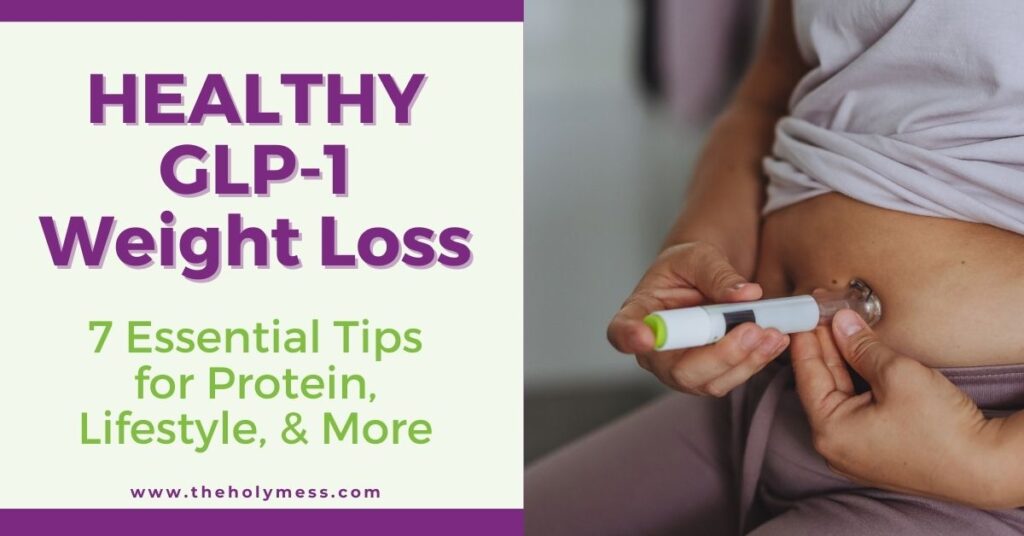
Key Take-Aways for Healthy GLP-1 Management
- Prioritize protein and strength training
- Real food over processed shakes and bars
- Manage hydration, digestion, and mental health
Weight loss is the granddaddy of goals for many of us. As someone maintaining a 100-pound weight loss, I spent most of my life trying to be thinner, so I get it. But ultimately, you want to be thinner AND healthy. These new medications are so powerful that it’s essential to use a strategy for losing weight the right way, and unfortunately, many doctors don’t (or don’t have the time) to teach you.
As a weight loss coach who has been leading people in weight loss for over ten years, plus my experience of maintaining my weight loss for 20+ years, I’ve researched this topic extensively. Here’s what you need to know.
1. Eat Adequate Protein
All macronutrients (protein, carbohydrates, and fats) are essential, but protein becomes especially important when taking a GLP-1 medication like Zepbound or Retatrutide (coming soon). While your body can use stored fat and glycogen for energy, it cannot store protein in the same way, so you need a steady supply throughout the day.
Protein is especially critical because one of the biggest concerns with rapid weight loss of any type is losing muscle along with fat. Since muscle is metabolically active, losing it slows metabolism and increases the risk of weight regain when stopping GLP-1 treatment.
Aim for roughly 25–35 grams of protein per meal, ideally from foods like lean meats, Greek yogurt, or cottage cheese. If your appetite is low, focus on high-quality protein during your hungriest time of day. If you struggle to eat enough at all, ask your doctor about a dose adjustment, since adequate nutrition is essential for your health.
Action steps: Aim for 30 grams of protein per meal, ideally from real foods like lean meat, Greek yogurt, or cottage cheese. If you struggle with lack of hunger, focus on high-quality food intake during the time of day when you are most hungry. Use the days when your shot is wearing off as the time to boost your diet to its optimal level of nutrition. If you genuinely have no appetite, talk to your doctor about a dose adjustment. Never being hungry is not healthy.
2. Improve Your Diet Quality
I see two alarming trends within the community of people taking GLP-1s:
- Continuing to eat a junk-food diet, just in smaller quantities.
- Consuming a diet of protein shakes, bars, and these supposedly healthy processed foods instead of real food.
Let’s explore each of these in more detail.
1. STOP Eating a Junk Food Diet (in Smaller Quantities)
You might have decided to start a medication like semaglutide or tirzepatide because you think,
“I just want to be normal around food.”
Daily, people tell me they want to be “normal” with food. The problem is that normal is not healthy in first-world countries today.
Analyses of large databases (over 230,000 items) found that 71% of American food products are classified as ultra‑processed.
Because medications like Ozempic decrease appetite and slow digestion, you become full more quickly. You may consume half the amount (or less) of what you used to eat. For this reason, it’s critical to pay attention to every bite. Aim for nutrient-dense meals and snacks the majority of the time.
2. STOP Eating Protein Shakes & Bars Instead of Regular Food
Protein bars, drinks, and shakes (and now cookies, pretzels, puddings, and more) have their place, especially if you are learning to manage a smaller appetite.
However, these are processed foods. In fact, most are ultra-processed foods, which means they contain ingredients that cannot be found in your own kitchen.
Action steps: The goal of taking a weight loss medication is to become healthier. Experts agree that a diet high in processed foods is not healthy. Aim for 80% of your diet to be natural, wholesome foods.
3. Stay Hydrated
In the same way that GLP-1s reduce appetite, they reduce thirst for some people, so you no longer feel your body’s thirst signals accurately. You may need to drink even when you don’t feel thirsty.
Here is helpful guidance about how much to drink in a day, along with a free water tracker.
Constipation is a common issue for many people on GLP-1s, as these medications slow digestion. Drinking enough liquid is critical to maintaining a healthy digestive process. (It is possible to drink too much water, so be cautious not to overdo it.)
Action step: Plan what you’ll drink in advance and carry it with you. While plain water is best, all liquids count. Try drinking separately from meals if you struggle with adequate food intake.
4. Strength Training
Researchers are still learning why people tend to lose muscle while taking a GLP-1. Is it because of the medication itself or the rapid weight loss? Regardless, eating enough protein plus strength training is absolutely critical for people taking a GLP-1 medicines.
Some of the rapid weight regain that occurs when people stop taking GLP-1 medications may be due to the loss of muscle, which reduces metabolism.
Aim for 2-3 sessions per week of strength training to build muscle.
Action step: Incorporate strength training 2-3 times per week to prevent muscle loss during weight loss.
5. Manage Digestive Side Effects
Because GLP-1s slow your digestive system, managing symptoms becomes important. Common side effects include:
- Diarrhea
- Constipation
- Heartburn
- Nausea
Be especially careful about constipation, which can lead to serious health consequences if left untreated. After dealing with years of undiagnosed Sucrose Intolerance, I’ve learned how important it is to treat it properly.
Action Step: Treat digestive side effects, especially constipation, promptly.
6. Focus on Your Mental Health
There is some concern that GLP-1s can lead to increased mental health issues like depression and suicidal thoughts. Talk to your doctor right away if this is an issue for you.
In my experience, a far more common issue is that rapid weight loss brings rapid life changes that you aren’t prepared to handle.
Inside The Holy Weigh, our Christian weight loss program for women, we have many GLP-1 users and walk you step-by-step through navigating these changes. I’ve also coached a number of women taking weight loss injections where we create a personalized weight loss plan that fits your tastes and lifestyle.
My 100-pound weight loss was slow (happening over 3-4 years), but even still, I struggled with many of these:
- Self-sabotage – I wanted to lose weight, yet I was afraid of being in the spotlight. What if I gained it back?
- Identity – As much as I hated it, I had lived life as an overweight person. I didn’t know who I was without the layers of fat.
- PTSD – After a lifetime of dieting, plus watching both my parents die from obesity-related complications, I had a lifetime of built-up trauma around food and my body. That doesn’t just go away because the number on the scale changes.
- Emotional overwhelm – I used food as a buffer for things I didn’t want to feel. I ate when I was stressed, bored, angry, or tired. When the ability to overeat is taken away, you’re left with a flood of feelings to cope with.
- Body dysmorphia – Even though I knew my body was smaller, I couldn’t see it. I felt big and always headed to the plus-size section of the store, even years after I lost weight.
- Anxiety – I worried about regaining weight, if healthy food would be available, and was generally anxious about maintaining my new lifestyle.
- Relationship issues – Our culture is very food-focused, and eating differently impacts relationships and social situations. There’s also stigma around taking weight loss shots as cheating or being somehow morally wrong.
Action Step: You are going through a huge life change, and it may be happening quickly. Expect that you’ll feel some ambivalence during the process. Consider therapy if you are struggling to cope.
7. Manage Medication
While people accuse those who take GLP-1s of taking the easy way out, it’s not a simple situation.
Obtaining this medication often includes:
- Additional doctor appointments, tests, and check-ups
- Insurance battles, pre-authorizations, and proof of other weight loss methods you’ve tried
- Handling medication shortages
- Dealing with side effects
- Concerns that you will no longer qualify for insurance coverage once you reach your goal weight. (GLP-1s are approved for weight loss, not maintenance.)
- If you are paying out of pocket, concerns that you won’t be able to continue to afford it.
- If you are taking a compounded version, concerns about potential bans or safety and efficacy issues.
- If you are keeping the information private, concerns that people will find out.
Action Step: Plan time and emotional energy for medication management.
Give yourself grace. You are in a huge life transition. While it’s overall positive, it is a lot to manage, and it may be coming at you quickly.
Losing weight with a GLP-1 medication is a powerful tool, but there’s more involved. By eating enough protein, building muscle, managing side effects, and caring for your mental health, you’ll create a strong foundation for health that lasts for a lifetime.
Share in the comments below: If you are taking a weight loss drug, are you following these steps? If you are not taking a weight loss medication, did you know the challenges faced by those who use them?
Wondering if taking a GLP-1 is cheating as a Christian? Read my Christian view of GLP-1s.
GLP-1 Weight Loss Series
Weight Watchers Medication Program
Weight Watchers 7 Day Basic Meal Plan









Thank you so much for sharing this.
After being on diet after diet, I have now been on Wegovy for 8 months and have lost 42 lbs.
But I hit a plateu recently and didn’t know what I was doing wrong.
My Dr, suggested I wasn’t eating enough, and not consuming enough protein, but I just did’t feel like eating.
My thyroid went from hypo to hyper and I began feeling bad throughout the day.
This article explained a lot and I’m turning things around now eating whole food meals with protein.
I’m trying to follow the Weight Watchers diet, and hopefully that will get me back on track.
Thanks again!!!
Hi Cathie,
LaNette here with The Holy Mess. I use the WW app. Are you using the app or doing WW on your own? I love that the WW app updated to include macros. Now I know that I’m eating plenty of protein.
Congrats on your weight loss! Great job.