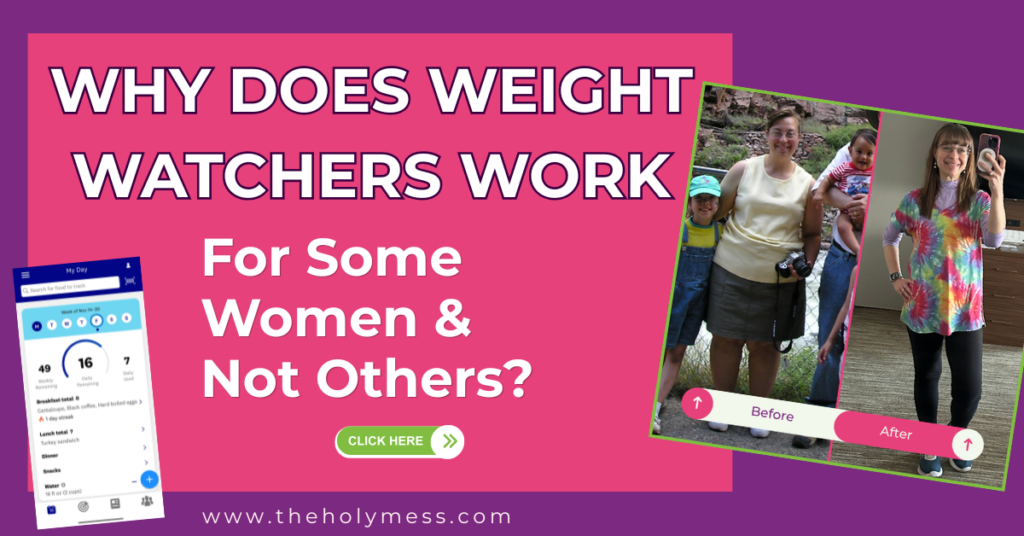
Picture two women sitting in their kitchen, using the Weight Watchers app to track points. For both of them, it’s the first day of their new program. They are both starting at the same weight. They are both following the same plan.
Six months later, one has lost 40 pounds, the other has gained five. What’s going on? (And no, the answer is NOT weight loss shots or menopause.)
As a weight loss coach and leader, I’ve seen this hundreds of times. Why does Weight Watchers work for some women and not others?
Truthfully, I’ve been both women at different times along my weight loss journey.
What’s the difference between those who succeed and those who don’t? Why did WW work for you before, and now it doesn’t? Or maybe you lost some weight counting points, but now you’ve hit a WW plateau. Read on to find out, because the answer will probably surprise you.
- What WW Gets Right
- WeightWatchers Worked for Me – Until It Didn't
- The 5 Reasons WW Stops Working
- Why Some Women Succeed on Weight Watchers Long-Term
- WW vs. Addressing Soul Hunger — A Comparison
- So, Should I Quit WW?
- The Missing Piece Nobody's Talking About
- Your Next Step
- Feeling Stuck? Take This Free 3-Minute Weight Loss Sabotage Quiz
What WW Gets Right
While no weight loss plan is perfect, there’s a lot that Weight Watchers does really well, which is why U.S. News & World Report has listed WW as a top diet program for years.
Here are the strengths of the WW system:
- All foods are allowed. No food is off limits, which makes the program realistic and doable to maintain long-term. You have flexibility to make the plan work for you and your lifestyle.
- Healthy food choices. The WW points system steers members into choosing healthy foods, especially the zero point foods.
- Community support. Although some in-person meetings have closed, they are still available in many cities, plus hundreds of virtual meeting options. The Weight Watchers program weigh-ins give members accountability and rewards for their progress, too.
- Research-based guidance is built into the program for behavior change, diet, and exercise.
- Practical, on-the-go tools. The WW app is a gold mine of resources with the daily points tracker, recipes, workout videos, WW community, and more. Tracking is easy to do while on the go. Points can be like a game, which makes it more fun and motivating compared to calories.

I lost over 100 pounds counting points and reached Lifetime status, so I’m not anti-Weight Watchers and you won’t see me bashing their system.
WW gave me the framework I needed because when I was 125+ pounds overweight, my eating was in total chaos. I was binging regularly, secretly eating, and addicted to junk food, sugar, and fast food. I needed some type of system to help me regulate my eating, and WW gave it to me.

But these days, I’m also honest about what was missing.
WeightWatchers Worked for Me – Until It Didn’t
After several years of maintaining, I gradually realized that there were some big flaws with the points program, and some of them were rather concerning. After working with many women through our free challenges, coaching, and The Holy Weigh weight loss system, I know I’m not the only one who struggles with these.
The 5 Reasons WW Stops Working
Here are the top reasons that the points system may stop working for you.
1. Weight Watchers Doesn’t Address Emotional Eating
Weight Watchers does a great job of telling you what to eat, but they skip over why you eat. My endless rounds back and forth to the kitchen all evening long weren’t about points or calories.
You can pick all the 2 points snacks and munch on zero-point popcorn all evening, but none of that is fixing the deeper issue of why you feel the need for all those kitchen detours in the first place.
For much of my life, I used food to soothe myself, especially at the end of a long day. Food was my best friend and my worst enemy. I used it to cope when life felt too big and overwhelming. Food was my drug of choice.
WW coaches might mention emotional eating in a meeting here or there, but addressing stress eating as a root cause isn’t a key aspect of their program. I call emotional eating “Soul Hunger”, which is that void inside us that food was never meant to fix. (Check out this food triggers quiz to learn more.)
That’s why inside The Holy Weigh, our exclusive weight loss program, we address ALL aspects of weight loss – hunger, habits and heart.
“I’ve been doing Weight Watchers since 1970. I’ve learned more from Sara
in two weeks than I ever got from WW. I wish I had known about my
“toddler” brain years ago!” -Marytha Pitt
2. It Uses Shame as a Motivator (Even If It Doesn’t Mean To)
While it’s unintentional, for some women, Weight Watchers triggers shame and unhealthy black and white thinking. Weight Watchers themselves even issued an apology in recent years, saying they did a lot that contributed to fat shaming and unhealthy diet culture.
When foods are labeled with points, it’s easy to slip into the belief that lower points is good and higher points is bad, which quickly becomes “I’m good when I eat low points,” and, “I’m bad when I go over my daily points.”
For years, I felt so justified and even strangely proud when I ate very little. The lower I kept my points, the more successful I felt. Hunger was to be denied and pushed aside because what did it know? I was losing weight, darn it. I was conquering my hunger!
I didn’t understand that trying to eat so little was only setting myself up for failure, because it triggered the primitive hunger, overeating, and binge eating that I so desperately was trying to stop.
For many women, especially those of us with 50+ pounds to lose, this shame can set us up for being on-and-off, with a never ending loop of starting over on Monday.
3. Counting Points Can Lead to Disordered Eating Habits
Weight Watchers is careful to say that people with eating disorders should not use their program. I never heard binge eating addressed specifically in all the WW meetings I attended (hundreds over the years) as part of the curriculum. Members would mention it on occasion, but mostly we kept it hidden. I was secretly binge eating while using WW, and I am sure I am not alone.
It’s easy to start ranking food as allowed and not allowed because of their points value. I became someone who would eat 21 grams of peanut butter (3 points) but not 22 grams (4 points)…unless I was standing in the pantry eating it from the spoon, in which case, who’s counting?!
I’ve seen this in many women I work with who immediately shun certain healthy recipes or foods because it’s “too many points”, yet the meal is reasonable and should fit into a woman’s daily calorie allowance easily.
Example: I would NEVER buy a full-sized candy bar (13 points, half my 23 points for the day), yet I didn’t think anything of buying a bag of mini-candy bars (2 points each)…and then I would eat the entire bag over the course of the weekend (64 points).
In the quest for finding the lowest point foods possible, many women inadvertently switch from a diet of whole foods (2% milk, cheese, and whole wheat bread) to sugar-free, fat-free everything. (I see a similar concerning pattern with women taking GLP-1 medications who start with a diet of regular food and find themselves living on protein shakes and bars.)
While I don’t believe WW causes eating disorders, today as a certified binge eating and bulimia recovery coach, I certainly see how this type of system can exacerbate unhealthy eating patterns in those of us who are predisposed to this kind of thinking.

4. Weight Watchers Points Stop Working
Many WW members learn to game the WW points system, just like with my peanut butter example above.
One serving (1 Tbsp) of zero-sugar coffee creamer is zero points, 2 Tbsp is 1 point. Keep your serving size low enough and you never have to count creamer. After all, you tell yourself, it’s only 15 calories, what’s the point. Yet a bottle of creamer is 945 calories. Those calories are going somewhere, and that’s into your body. They aren’t evaporating.
A trend I’ve noticed lately with coaching clients and women in our programs is that they eat zero point foods through the day in order to save up their points for evening snacks.
Saving 15-20+ points for snacking makes you a prime candidate for evening overeating. Besides coming into the nighttime half-starving, you’re spending a lot of your daily calorie allotment on junk food.
Then these women moan that surely something is wrong with their metabolism, because they “followed their points” yet they can’t lose weight. Zero points does not mean zero calories.
Let me say it louder for the people in the back: Zero points does not mean zero calories.
There are also situations where WW math isn’t mathing. Only my WW peeps will understand how 1+1 can equal 3. For those who aren’t indoctrinated into the points world, certain foods are just on the line of being 1 point but really close to 2 points. When you eat one serving of these foods, it’s 1 point, but when you eat 2 servings (which you would think would be 2 points), instead it’s 3 points. These are the times you just want to step off the WW points crazy train – and when many people quit, heavier and more frustrated than ever.
5. Commercial Diet Plans Don’t Address What Happens If You Stop
Some people are content with a lifetime of tracking points, but I’ve met so many women who tell me, “I don’t want to be stuck tracking for the rest of my life.”
Is it possible to learn to eat mindfully? I believe, yes. Tracking what you eat is a fantastic strategy, and the research proves it. It’s what I recommend for any woman getting started with weight loss, and it’s the technique I always come back it if I have a weight regain.
But I also believe that tracking isn’t required forever. By addressing the root issues behind your overeating, mindful eating is possible for many women.
Even if you choose to continue tracking, mindful eating is still important. It’s tempting to give in to overeating “because I have the points for it”, but that will keep you stuck on a plateau.
The goal isn’t to count points forever. Ideally, the goal is to not need to.
WW has a Lifetime program for those who get to their goal weight, but I was shocked when I got it, and there was no information from WW about how to stay within a healthy weight range.
Now that I’ve been maintaining for 20+ years, I’ve discovered that there are additional skills required for staying at goal, so I include that information inside The Holy Weigh and incorporate those skills into the coaching offers I provide.

Why Some Women Succeed on Weight Watchers Long-Term
The women who succeed long-term aren’t the most disciplined. They’re the ones who address what’s underneath.
Many women search for answers when Weight Watchers stops working. Maybe you’re stuck in a WW plateau, restarting every Monday, or following your points perfectly but still not losing weight. If that’s you, the issue may not be lack of discipline. There’s often a deeper reason underneath the overeating, cravings, and constant food thoughts.
Inside The Holy Weigh, we use a 3-step framework to get to the heart of why you turn to food in times of stress, overwhelm, or frustration:
- Satisfy your hunger.
- Stack your habits.
- Heal your heart.
Our faith-based weight loss system helps you overcome emotional eating by getting to the root issue of why you overeat in the first place.
“Oh my goodness, 11.6 pounds in 30 days and in Onederland! I haven’t seen that in a long time!” -Christy Rickert
WW vs. Addressing Soul Hunger — A Comparison
Here’s what I see when I compare The Holy Weigh with other commercial diet programs.
| Factor | Diet Programs (WW, Noom, etc.) | The Holy Weigh |
| Focus | WHAT you eat | WHY you eat |
| Method | Points | S.A.F.E. Eating |
| Emotional eating | Rarely addressed | Central focus |
| Faith component | None | Biblical, Christianity |
| End goal | Lifetime in program | Become a Holy Weigh Warrior |
| Community | Meetings/app | Soul Full Sisters, Sanctuary (group), Live weekly video Q&A exclusively for members |
So, Should I Quit WW?
Ultimately, you will need to decide for yourself if Weight Watchers is right for you. I am still a Weight Watchers member and use their points system at times. I also use other apps like My Fitness Pal, and sometimes I don’t track at all.
While I still am very intentional about my food choices every day, I also have food freedom in ways I never thought would be possible.
Here are 5 self-reflection questions to use as you consider what’s best for you:
- Do you dread weigh-in day more than you look forward to it?
- Have you “restarted on Monday” more than 5 times this year?
- Do you eat well all day, then binge at night?
- Does counting points feel like a full-time job?
- Have you tried everything and still feel stuck?
If you said yes to 3 or more, the issue probably isn’t WW. It’s something deeper, and our 3 triggers quiz is your next step to discovering what it is.
The Missing Piece Nobody’s Talking About
Soul Hunger is using food to fill a void that only God was meant to fill. All of us have a void inside of us. This feels like a loneliness, an ache, a need for something more.
Turning to food will never fill this need, because food was never meant to fix it. I spent decades of my life trying to fill that void with food, and it never worked. No matter how much I ate, it wasn’t enough. I ate until I was physically sick and literally couldn’t eat any more, and yet I still wasn’t satisfied, because only God can fill the void that is meant for Him.
I was baptized as a baby, and I’ve been a Christian all my life. During my growing up years and in my early adult life, I went to church almost every Sunday. I lived my life in service to God and others.
I wasn’t wrestling with the concept of God.
I wrestled with how to allow God to fill this void, because to me it just felt like Hungry Hungry Hippo. I craved food all the time, and I was rather clueless about what that had to do with my faith. Inside The Holy Weigh, I’ll walk you step-by-step through what I learned, and how you can experience the satisfaction that only God provides too.
Your Next Step
Take our Weight Loss Self-Sabotage Quiz to uncover the hidden patterns behind emotional eating, nighttime overeating, and constant food noise.
Feeling Stuck? Take This Free 3-Minute Weight Loss Sabotage Quiz
Most women who struggle with their weight are dealing with something deeper. Take this quiz to find out what’s really triggering you:
If you want to stick with the WW system, go for it. And if it’s time to say goodbye, we are here to support you through that process, too.
Learn More
Quitting Weight Watchers? – Here’s what to do next.
I Canceled WW – Why does it feel like a breakup?
When WW Stopped Working for Me – What I did when I stopped counting points.
7 Steps to Christian Weight Loss – Make God the center of your weight loss process.










Leave a Reply